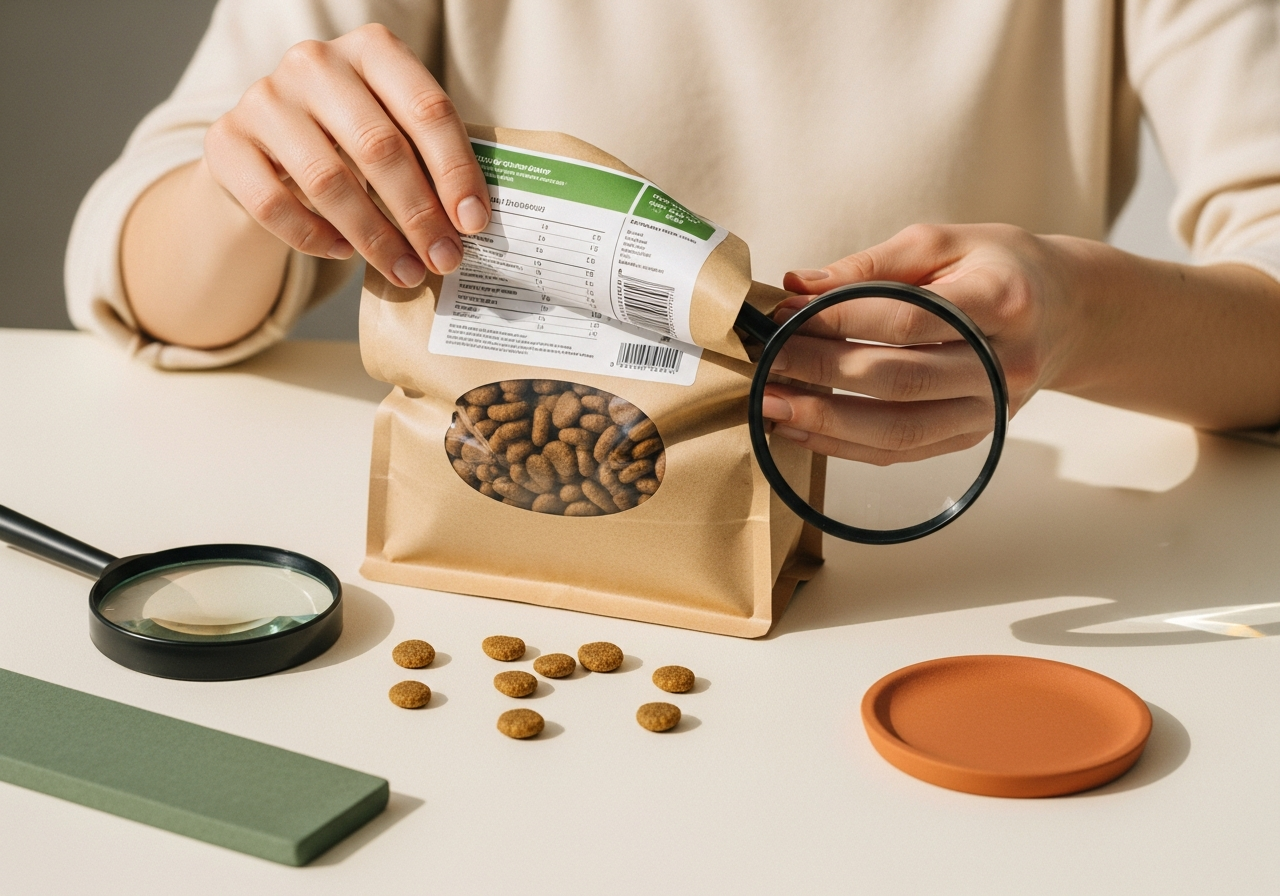
Don't let the front of the bag fool you. Here's what to look for on the back.
The front of a dog food bag is pure marketing. The ingredient list is where the actual information lives — and once you know what to look for, it gets a lot easier to tell the difference between a thoughtfully made food and one that's dressed up to look that way.
Why Ingredient Order Matters
Ingredients are listed by weight, heaviest first. So if chicken is listed first, there's more chicken in the bag (by pre-cooking weight) than anything else. That part's straightforward.
Where people get tripped up is ingredient splitting — a manufacturing practice where a less desirable ingredient is divided into smaller components to push it further down the list. Corn, for example, might appear as "corn meal," "corn gluten meal," and "whole grain corn" — three separate listings, each in smaller amounts. Combined, they might outweigh the protein source at the top. It's not illegal. But it's worth knowing about.
A good place to start is to look at the first five ingredients. They tell you the most about what you're actually feeding your dog.
What "Meal" Actually Means
Seeing "chicken meal" on an ingredient list isn't something to panic about. Meat meal is a concentrated protein source — the moisture has been removed, which means pound for pound, it often delivers more protein than fresh meat listed by itself. Fresh chicken is roughly 70% water; by the time it's processed, it may rank lower than it appears.
So "chicken" listed first followed by "chicken meal" second is actually a decent sign. Two forms of the same named protein, one fresh and one concentrated.
What you do want to avoid is generic "meat meal" or "poultry meal" with no species named. That vagueness exists for a reason, and it's not a good one.
The Preservative Question
Some preservatives are fine. Some are worth a second look. Here's how we'd think about it:
Mixed tocopherols (a form of vitamin E) are a common preservative in better-made foods — stable enough for shelf life, and you don't need to worry about them. Same with ascorbic acid (vitamin C) and rosemary extract.
BHA, BHT, and ethoxyquin are the ones that raise flags. They're synthetic preservatives, and while the research isn't fully settled, enough questions have been raised that many thoughtful manufacturers have moved away from them. If you see them listed, it's a reasonable thing to note.
The absence of synthetic preservatives doesn't make a food good — but their presence is worth knowing about, especially in a food your dog eats every single day.
Fillers vs. Functional Carbohydrates
"Fillers" is a word that gets thrown around a lot, and it's not always accurate. Some carbohydrates serve a real purpose — binding kibble together, providing fiber, supporting digestion. The question isn't whether carbs exist in the food, but which ones and how much.
Ingredients like sweet potato, lentils, chickpeas, oats, and brown rice show up in shorter ingredient lists and tend to come from more traceable sources. They're doing something. Ingredients like corn syrup, artificial colors, or unnamed "animal digest" are a different story — those are there for palatability or cost, not nutrition.
One thing worth knowing: legumes (peas, lentils, chickpeas) have received scrutiny in connection with dilated cardiomyopathy (DCM) in dogs. The FDA opened an investigation in 2018, and while the science hasn't landed on a definitive cause-and-effect, it's a legitimate conversation to have — especially for large breeds or dogs with any cardiac history. Ask your vet if this is something you want to think through for your specific dog.
What a Short Ingredient List Usually Signals
It's not a rule, but it's a useful pattern: shorter ingredient lists tend to come from manufacturers who are making deliberate choices about what goes in the bag. When a brand names its protein source, its carbohydrate source, and its fat source — and stops there — it's usually because they're not trying to hide anything.
Brands like Open Farm, Koha, Smallbatch, and Vital Essentials have built their entire product lines around this approach. You can read their ingredient lists in under a minute and understand exactly what you're looking at. That transparency matters, especially for dogs with sensitivities where you need to actually trace an ingredient back to its source.
Raised Right, Portland Pet Food Company, and A Pup Above are worth looking at too — smaller operations with short, honest ingredient lists and real sourcing accountability.
Every pet is different, but if your dog is doing well on their current food — healthy coat, good energy, solid digestion — an ingredient list is confirmation, not necessarily a reason to switch. If something's off, the ingredient list is often the best first place to look.
One Thing You Can Do Today
Pull out whatever bag or can you're currently feeding and find the ingredient list. Count how many ingredients there are. Then look at the first five. Can you identify what each one is? Do you see a named protein, or something generic? Are there three different forms of the same grain? That five-minute exercise tells you more than any front-of-bag claim ever will.
The Bottom Line
The ingredient list is one of the most useful tools you have as a dog owner — and it doesn't require a nutrition degree to use. Look for named proteins, short lists with recognizable ingredients, and preservatives you can actually pronounce. If what you see raises questions, that's a good sign you're paying attention.