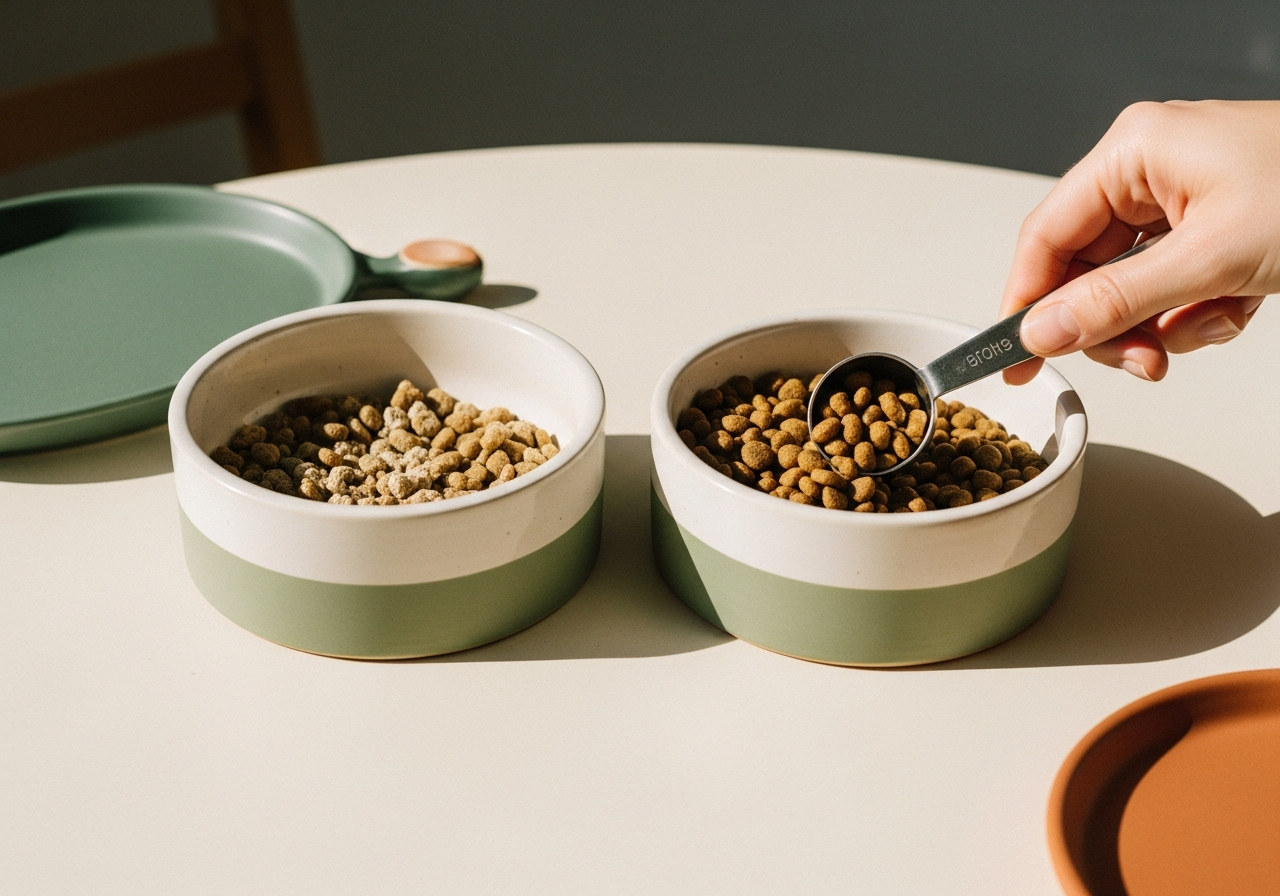
Most food transitions fail in the first three days — not because the new food is wrong, but because the switch happened too fast.
It's one of the most common mistakes well-meaning pet owners make. You find a better food, you're excited about it, and your dog or cat gets a full bowl of something new the next morning. Then comes the loose stool, the vomiting, or the flat-out refusal to eat. Suddenly you're second-guessing the new food entirely, when really the food itself was never the problem.
Here's how we'd think about it: your pet's digestive system is a finely tuned ecosystem. The bacteria in their gut — their gut microbiome — is calibrated to whatever they've been eating, even if that food wasn't great. A sudden shift throws that system off balance before it has a chance to adapt. A slow transition gives those microbial populations time to adjust, and it gives you time to read how your pet is actually responding.
The Standard Transition Schedule (And When to Slow It Down)
A good place to start is the 10-day rule. It's not magic, but it works for most healthy adult dogs and cats:
- Days 1–3: 75% old food, 25% new food
- Days 4–6: 50% old food, 50% new food
- Days 7–9: 25% old food, 75% new food
- Day 10+: 100% new food
Why Cats Need Extra Patience
Cats deserve their own mention here because they can be genuinely difficult to transition, and not always for digestive reasons. A cat that refuses the new food on day one isn't necessarily being picky — they may simply not recognize it as food yet.
Food imprinting is real in cats. Many develop strong preferences for specific textures, shapes, and flavor profiles early in life, and anything outside that narrow band gets ignored or rejected. If you're switching from a dry kibble to a wet or raw format, that's a significant change in texture and moisture — and cats notice.
For cats, a slower blend over two to three weeks helps, but mixing textures can sometimes backfire. A better approach for format-switching is to offer the new food in a separate small bowl alongside the familiar one, letting curiosity do some of the work. Don't let a cat go more than 24–36 hours without eating, as prolonged food refusal can lead to hepatic lipidosis, a serious liver condition. Ask your vet if your cat is holding out past the two-day mark.
Reading the Signs: What's Normal, What's Not
Some soft stool in the first few days of a transition is normal and not cause for alarm. So is a slight decrease in appetite as your pet adjusts to unfamiliar smells and flavors. These are speed bumps, not stop signs.
What you don't want to see is vomiting more than once or twice, blood in the stool, lethargy, or signs of serious GI distress. If any of those appear, stop the transition, go back to the old food, and ask your vet if there's something else going on — an underlying sensitivity, an allergy, or just a food that isn't the right match for your specific animal.
The transition process itself is valuable diagnostic information. How your pet responds tells you a lot about their digestive resilience and whether the new food is genuinely agreeing with them.
Choosing a New Food That Makes the Transition Easier
Not all foods transition equally. A switch between two foods with similar protein sources and ingredient profiles will almost always go smoother than jumping from a corn-and-chicken kibble to a raw frozen patty.
If you're making a significant format change — dry to wet, kibble to freeze-dried, or anything to raw — consider using an intermediate step. Brands like Stella & Chewy's and Primal Pet Foods make freeze-dried raw options that rehydrate easily and sit somewhere between kibble and raw in terms of digestibility. They're also short on ingredients, which makes it easier to identify what's working and what isn't.
For wet food transitions, Koha and Smallbatch are worth knowing. Koha's limited-ingredient pouches have a single animal protein and not much else — genuinely useful when you're trying to isolate a variable. Smallbatch uses small-batch processing with named sourcing, and their variety of formats (frozen raw, freeze-dried) gives you flexibility depending on where your pet is in the transition process.
One concrete thing you can do today: before you open the new bag or can, write down what your pet is currently eating in full detail — brand, protein source, format, and any supplements. When you start the transition, note daily what ratio you're feeding and any changes in stool, energy, or interest in the food. A week of that simple log will tell you more than any label ever could.
The Bottom Line
Switching your pet's food is worth doing carefully — not anxiously. A 10-day gradual blend works for most pets, but cats and sensitive animals often need more time, and that's completely fine. The transition itself is just as important as the food you're transitioning to, so slow down, watch closely, and let your pet's response guide you.