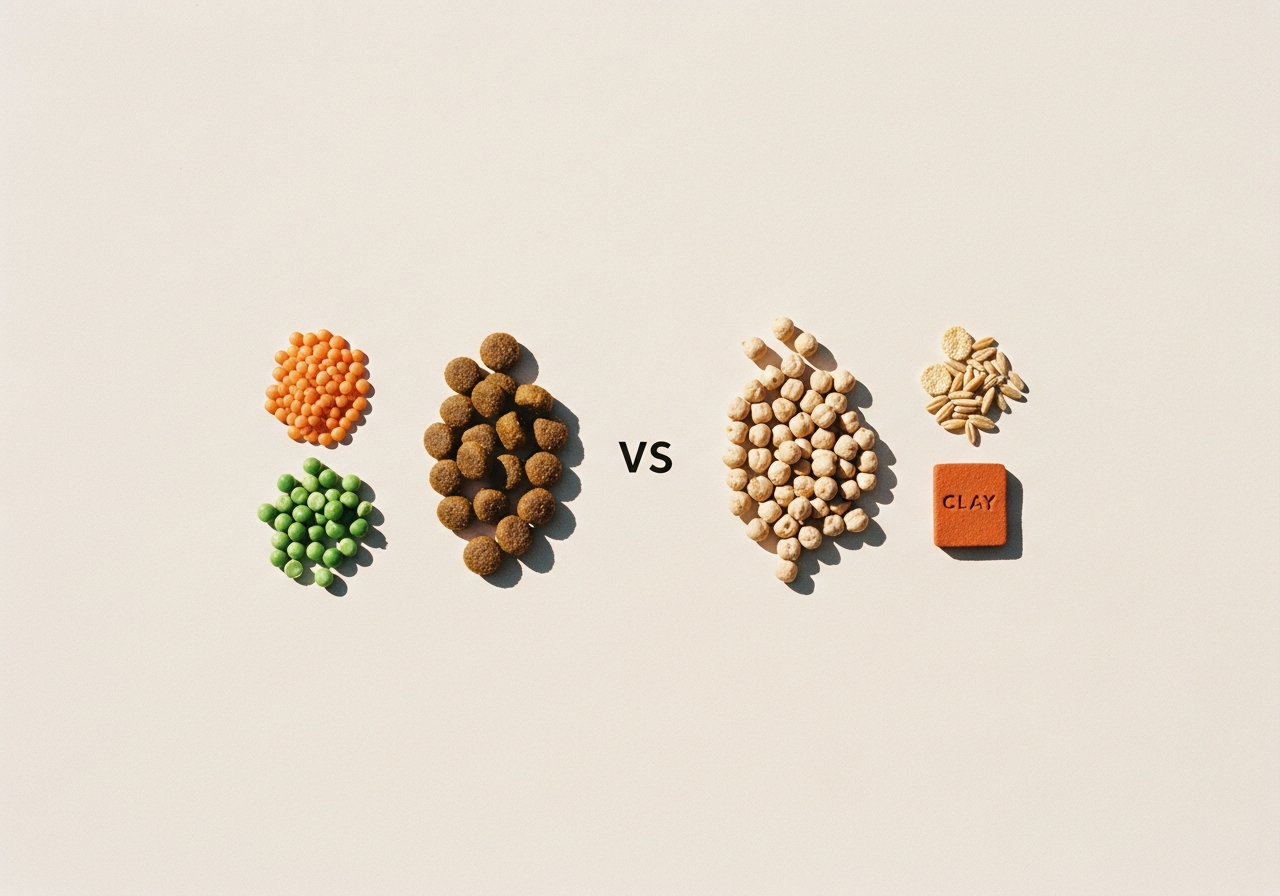
Grain-free dog food took over pet store shelves fast — and the marketing machine moved so quickly that most people never stopped to ask what they were actually buying into.
What "Grain-Free" Means on the Label
At its most literal, grain-free means the food contains no wheat, corn, rice, barley, oats, or other cereal grains. That's the whole definition. It says nothing about the quality of the other ingredients, how the food was made, or whether it's a better fit for your dog.
What tends to fill the gap left by grains? Usually legumes — lentils, peas, chickpeas, and potatoes. These aren't inherently bad ingredients, but they're doing a job that grains used to do: providing carbohydrates, fiber, and binding structure for kibble. Swapping corn for peas isn't automatically an upgrade. It depends on the dog, the food, and the context.
Grain-free is a description of what's missing — not a promise about what's there.
Why People Started Avoiding Grains
The grain-free movement grew out of a reasonable instinct: a lot of mass-market dog foods used grains as cheap filler, and people wanted better. Corn syrup derivatives in pet food are a legitimate concern. Wheat used as the primary protein source in a low-quality food is a legitimate concern.
But somewhere along the way, grains themselves became the villain — and that's where the logic got fuzzy. The problem was never grains as a category. The problem was low-quality ingredients used to pad out a nutritional profile that didn't hold up to scrutiny.
Actual grain allergies in dogs exist, but they're far less common than the marketing would suggest. True food allergies in dogs most often point to animal proteins — beef, chicken, dairy — not grains. If your dog is itchy, gassy, or having recurring ear infections, it's worth investigating, but grain-free food isn't the automatic answer.
The DCM Question — And Why It's Still Unresolved
In 2018, the FDA began investigating a potential link between grain-free diets and dilated cardiomyopathy (DCM), a serious heart condition in dogs. The concern centered on high-legume formulas — specifically foods where peas, lentils, or potatoes appeared near the top of the ingredient list.
This got a lot of press, and it created a genuine wave of anxiety among dog owners who had switched to grain-free on the assumption they were doing something healthy.
Here's how we'd think about it: the research is still ongoing, and the picture isn't clean. The FDA hasn't issued a definitive causal finding. DCM is a complex condition with multiple contributing factors, including breed genetics. Golden Retrievers, Dobermans, and Great Danes are already predisposed. Some cases appeared in dogs eating grain-free food; others appeared in dogs eating grain-inclusive food.
What the investigation did reveal is that formula transparency matters. Foods that clearly name their protein sources, show their ingredient sourcing, and don't rely on legumes as the dominant carbohydrate source are easier to evaluate. That's worth keeping in mind regardless of where the DCM research ultimately lands.
Ask your vet if your dog is a breed with known cardiac risk — that's a case where the grain-free question becomes worth a real conversation rather than a label read at the store.
So Does It Actually Matter?
For most dogs eating a balanced, well-sourced diet — probably not much, in either direction.
Every pet is different, but if your dog is thriving on a grain-inclusive food with good protein sources and a short, readable ingredient list, there's no compelling reason to switch. Conversely, if your dog has a diagnosed sensitivity or simply does better on a grain-free formula, that's meaningful real-world information.
A good place to start is ignoring the front-of-bag claims entirely and flipping to the ingredient list. The first three to five ingredients tell you most of what you need to know. Named meat sources — chicken, salmon, beef — should lead. Whether the food includes brown rice or lentils after that is a secondary consideration.
Brands like Open Farm, Smallbatch, Koha, and Ziwi Peak make both grain-inclusive and grain-free options with clear sourcing and short ingredient lists. Farmina has done meaningful nutritional research and offers grain-free and ancestral-grain formulas side by side, which is worth exploring if you want both options from a brand that's thought carefully about it. The Honest Kitchen and Raised Right offer whole-food formats with transparent ingredients that make the grain question almost beside the point — you can see exactly what's in the food.
One Thing You Can Do Today
Pull out whatever food you're currently feeding your dog and read the ingredient list — not the front of the bag, not the marketing copy on the website. Look at what appears in the first five ingredients. Is there a named protein source first? Are there three or four legumes stacked in a row? Does the list read like something you could mostly identify?
That five-ingredient audit will tell you more about what your dog is actually eating than any label claim — grain-free or otherwise.
The Bottom Line
Grain-free isn't a health category — it's a formulation choice, and like most formulation choices, context is everything. The quality of the ingredients, the transparency of the brand, and how your individual dog responds matter far more than whether the bag has a grain in it. If you're choosing between two well-sourced foods and one happens to include brown rice, that's not a reason to reach for the other one.